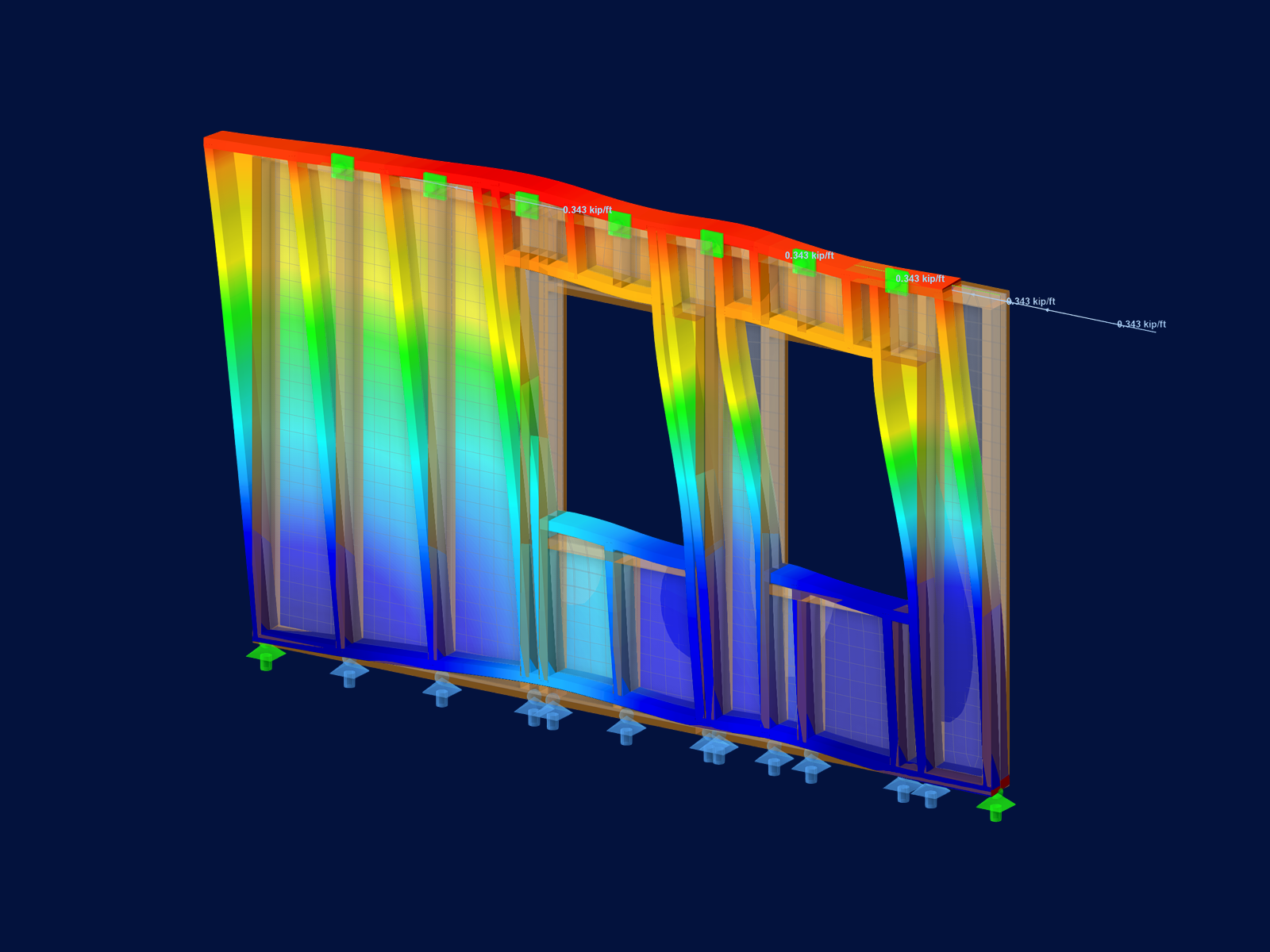
ASTM E1300-24 Insulated Glass Design in RFEM 6
A walkthrough of laminated and insulated glass design in RFEM 6 with the Glass Design add-on, built around three glass panels modelled from scratch. The session covers how a glass composition is built up layer by layer, when a 2D surface model is enough and when a 3D solid is required, how shear coupling between the layers is treated in each case, and how climatic loading applies to an insulated unit. It closes on the ASTM E1300-24 checks — stress against the code allowable, and deflection against the limits set in the add-on.

Presented by
Webinar language
 English (US)
Recommended skill level
Skills you will gain
- Build up laminated and insulated glass as a layered composition in RFEM 6, and save recurring build-ups to the template library
- Judge when a glass build-up permits a surface model, when it calls for a solid, and when a gas layer leaves no choice
- Set shear coupling on a surface model, and recognise where a solid accounts for the true coupling within the calculation
- Generate glass load combinations to ASCE 7 for strength and to the IBC for serviceability, with a load duration on each case
- Interpret ASTM E1300-24 design ratios for principal tensile stress, edge stress, and deflection on surfaces and solids
This webinar includes
Webinar content
Amy Heilig introduces the session alongside moderators Alex Bacon and Cisca Tjoa, explains how questions are handled, and outlines the agenda: three glass panels modelled in RFEM 6 with the Glass Design add-on, the surface versus solid distinction, shear coupling, climatic loading considerations, and the ASTM E1300-24 design checks, with an earlier webinar linked for background.
Modelling runs from activating the Glass Design add-on and building glass compositions layer by layer out of the material library, through line and nodal supports and copying the panel into laminated and insulated variants, to slides contrasting surface and solid models, shear coupling, and spacer settings, and finally the generated solids and the FE mesh.
Load cases for dead, wind, live, and the self-straining climatic actions for summer and winter are set up with their load durations, then combined automatically to ASCE 7 and, for serviceability, the IBC. An exclusive relationship separates summer from winter, loads are applied and corrected to the right reference plane, and the strength and serviceability design configurations are set.
With the calculation finished, the static analysis results are reviewed: global deformations cycled through the load combinations, surface stresses on the two-dimensional panel selectable by layer and layer side, principal stresses in the solids, the pressure in the gas solid, and support reactions, all mirrored in tables that export to Excel.
The ASTM E1300-24 checks are then read off: warnings that gas and interlayer solids are not designed, design ratios on surfaces and on solids, and check details setting the demand stress against the code allowable, at the edges or the centre. A cross-section results diagram shows principal and shear stresses through the insulated build-up.
Who this webinar is for
- RFEM 6 users analysing glass panels who want the ASTM design checks carried out on the same model as the static analysis
- Engineers weighing whether a laminated or insulated build-up requires a surface or a solid model
- Practitioners designing to ASTM E1300-24 in the United States who need the code check to run on the analysis model itself
Application areas:
Industry:
Standards:
Role:
Product:
Webinars review
I would like to thank you for the webinar on "Torsional Warping (7 DOF)". It was one of the best webinars I have ever seen. Thanks to your clear explanations and illustrative examples, I finally understood several things that I had not fully understood before.
Ing. Aleš Kupča
Statika KUPAL s.r.o.
I really enjoyed the coaching course on dynamic analysis. … It was a good introduction to the seismic design. A particularly positive feature is the option to use the various tools used in the training by downloading a demo version during the training—that was a really good addition.
Karen L.
TÜV NORD Ensys GmbH & Co. KG
I am a student at the Technical University in Nuremberg and am currently working on my master's thesis using Dlubal Software (RSTAB). The coaching course on dynamics (EC 8) was very helpful for me. The course was conducted in an extremely professional manner.
Gleb Chernyshev
Germany
The Concrete Structures EC2 with RFEM 6 course content was very satisfactory and well-structured, making it easy to follow. … In short, the course is interesting and introductory—a perfect introduction to the topic.
M.Sc. V. Zinkevych
Obermeyer Holding GmbH
I would like to thank you for the opportunity to try out RFEM 6. … I would like to mention that I'm excited about how much information and webinars you share.
Ing. Ida Grünwaldová
Czech Republic
Was an excellent Webinar | 2018 NDS CLT Design in RFEM 6! Thank you.
Juan Alberto Tello Fuente
CUMBRA INGENIERIA
Due to your webinars and test versions, I started a new job as structural engineer on January 1, 2023. For this, I would like to thank you and your team.
Dipl.-Ing. Ayman Al Shouha
Germany
Unfortunately, I didn't have the opportunity to follow the live webinar, but due to your recording, which I've watched, I am very excited about the current possibilities of RFEM 6. … I was particularly impressed by the speaker!
Prof. Dr.-Ing. Henning Lungershausen
University of Applied Sciences, Trier
Thank you, the webinar "The Most Common User Errors with RFEM and RSTAB" was very informative!
Dipl.-Ing. Adam Balogh
ThyssenKrupp Industrial Solutions AG
I would like to thank you again for the very good webinar "Stability Analysis in Steel Structures with RFEM and RSTAB". In some points, I was able to get clarity and it helped me a lot. I will probably use this more often in the future.
Dipl.-Ing. Johann Mair
MÜHLBERG Beratende Ingenieure GmbH, Mühlberg + Mair Beratende Ingenieure GmbH
The "Soil-Structure Interaction in RFEM" webinar presentation was excellent and the topic was very interesting.
Prof. Lazaros Vasiliadis
Democritus Univestity of Thrace (DUTH)
The webinar "Design Cold-Formed Steel Sections According to EC3" was great. It was my first webinar and I would like to follow more in the future. Especially for new users/students like me and if too fast, it is very good that it is recorded and you can watch it again.
Veronika Klöck
Germany
Thank you for the webinar "Design Cold-Formed Steel Sections According to Eurocode 3." I really liked it. The webinar recordings are a real plus point. Continue to do so!
Bernd Jäckel
Gesellschaft für Planung und Vermessung mbH
I really enjoy watching the webinars you showcase on YouTube. They helped me to convince my client to recently purchase RFEM. They provide a wealth of information.
William Lefort, P.Eng.
Danwill Canada
I have watched the webinar recording "Design of Cross-Laminated Timber Panels (CLT) According to Eurocode 5" on YouTube, and I am impressed by the program and the very good presentation.
Dipl.-Ing. Lothar Reichle
Ingenieurbüro für Statik und Baukonstruktion
The webinar about RWIND Simulation was very successful! From now on, it is possible to analyze wind forces on geometries of objects that are not regulated in the standard. The wind force assumption according to the standard was often a more or less good estimate.
DI Dr. techn. Wolfgang Billensteiner
Civil Engineering Office DI Dr. Tech. Wolfgang Billensteiner
Your webinar on RWIND Simulation was very impressive. Like the speakers at the info days, the speaker confidently described the performance of the new program.
Ing. Johann Tauß
Austria
RSTAB is a software program that I recently discovered and which is very helpful for the calculation of steel structures. With the webinars available on the Dlubal website, I have familiarized myself with the various functions of the program.
Daisy Amila
Algeria
I watched the webinar "Dlubal Information Day Online 2014 – Part 2: RFEM 5 – Structural Analysis with Finite Elements for Concrete and Steel Structures" from 2014. It is a good and powerful video!
Dipl.-Ing. Thomas Steinkühler
Bojda Planungsgruppe
I've attended the webinar on glass design. Excellent explanation. I don't design glass structures; however, it was very interesting to explore the potential of the software.
Ing. Simone Luca Tanghetti
Studio Tanghetti
I've been using Dlubal's programs for most of my university studies. In the beginning, RFEM was far from being a mainstream software, so I didn't have many colleagues to advise me, but thanks to the well-designed controls and webinars, I quickly learned how to work with it.
Ing. Martin Závacký
Brno University of Technology
The webinar Timber Connection Design in RFEM and RSTAB was very successful! I am particularly pleased that you explained how to select the SFS intec dowel system WS-T. Thank you very much!
Caroline Göttlein
SFS intec
Instructors

Amy Heilig, PE
CEO – USA Subsidiary
Amy is the CEO of the U.S. subsidiary and is responsible for sales and continued program development for the North American market.


Alex Bacon, EIT
Support Engineer
Alex handles customer training and technical support for the North American market and works on continued program development.
Cisca Tjoa, PE
Senior Support Engineer
Cisca is the senior support engineer for the North American market, covering customer training, technical support, and program development.
Related Webinars

Free