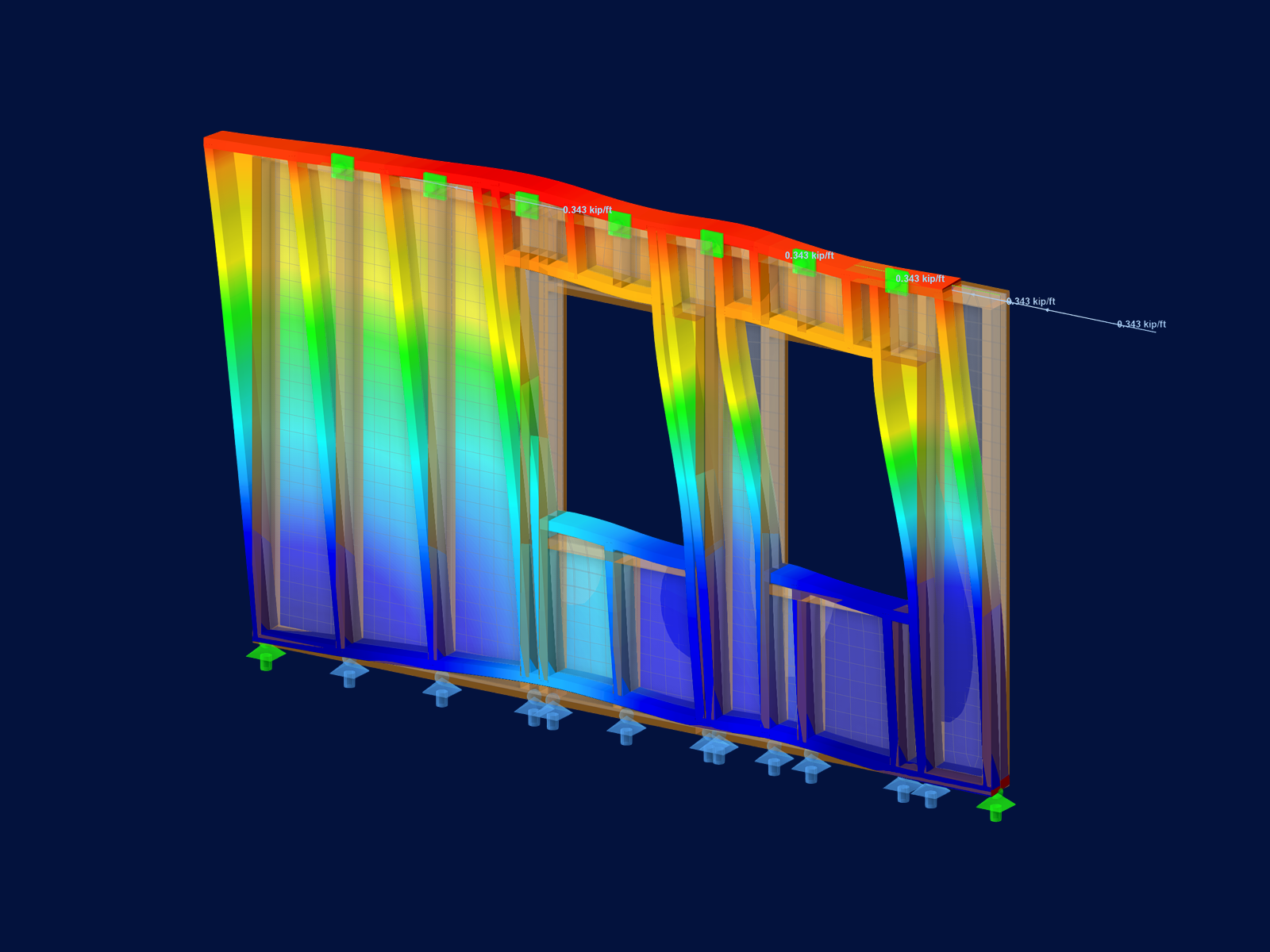
Nonlinear Reinforced Concrete Calculation in RFEM 6
The basics of nonlinear reinforced concrete analysis in RFEM 6, from the material model to two worked examples. The session first explains how concrete is modeled in tension and compression, how cracking is smeared over the finite elements, what tension stiffening contributes, and the two ways to include creep and shrinkage. A motorway bridge pier with a variable cross section is then checked for stability with the general method of Eurocode 2, and a two-story building is analyzed for deflection in the cracked state, first with linear creep and shrinkage and then with the Time-Dependent Analysis add-on.

Presented by
Webinar language
 English
Recommended skill level
Skills you will gain
- Choose isotropic or anisotropic damage for a concrete material and decide whether to apply tension stiffening
- Decide when the nominal curvature method no longer applies and the general method of Eurocode 2 is needed
- Set up a stability analysis of a concrete pier with nonlinear material, imperfections, and creep
- Apply creep and shrinkage to the quasi-permanent loads before the design loads in one load combination
- Compare cracked-state deflections with linear results and read the damage parameter and crack widths
- Run a time-dependent analysis with logarithmic time increments up to the final state
This webinar includes
Webinar content
Andreas Hörold opens the session, with Juliane Stopper-Akdag answering questions alongside him, and hands over to Marc Gebhardt. Marc outlines the plan: the theoretical background first, then two applications — a stability analysis with the general method and a deflection check in the cracked state — and an outlook on current development.
How concrete behaves in the nonlinear material model: linear elastic in tension up to cracking and then a smeared damage model, nonlinear in compression with softening, and a biaxial failure surface. The segment compares isotropic and anisotropic damage, explains tension stiffening and its models, and sets out the two ways to account for creep and shrinkage.
A motorway bridge pier with a variable cross section rules out the nominal curvature method of Eurocode 2, so the general method is used: nonlinear material, imperfections, and second-order analysis on the whole structure. The pier is then built from scratch, with the concrete and reinforcement materials, tapered sections, reinforcement, an imperfection, and the loads.
The combination wizard applies creep and shrinkage to the quasi-permanent loads first and the ultimate limit state loads on top, with a structure modification for the reinforcement stiffness. The results show the creep phase and the loading in the calculation diagrams, and the design check reads the internal forces against a three-dimensional failure surface.
Instead of the effective stiffness method, a two-story building is analyzed with nonlinear material: anisotropic damage, plastic reinforcement, mean values for serviceability, tension stiffening, and creep and shrinkage to Eurocode 2. The cracked-state deflections are compared with the linear elastic ones, and the damage parameter and crack widths show where the slab has actually cracked.
The same building is run with the Time-Dependent Analysis add-on, using time increments on a logarithmic scale after first loading. The deflection grows up to the final state, and its distribution changes as the ribs, slabs, and columns interact over time. The calculation diagrams set this against the linear creep and shrinkage approach.
Development under way: an anisotropic augmented tension stiffening approach that accounts for the angle between reinforcement and stress and for the position of the reinforcement over the thickness, damage results split into tension and compression, nonlinear results for members, integration into Concrete Design, and relaxation of prestressing steel and aging of concrete in the Time-Dependent Analysis add-on.
Who this webinar is for
- Engineers checking slender concrete piers or columns whose cross section changes over their height
- Engineers who need realistic slab deflections in the cracked state, including creep and shrinkage
- RFEM 6 users who rely on the effective stiffness method and want to see what a full nonlinear analysis changes
Application areas:
Industry:
Standards:
Role:
Product:
Webinars review
I would like to thank you for the webinar on "Torsional Warping (7 DOF)". It was one of the best webinars I have ever seen. Thanks to your clear explanations and illustrative examples, I finally understood several things that I had not fully understood before.
Ing. Aleš Kupča
Statika KUPAL s.r.o.
I really enjoyed the coaching course on dynamic analysis. … It was a good introduction to the seismic design. A particularly positive feature is the option to use the various tools used in the training by downloading a demo version during the training—that was a really good addition.
Karen L.
TÜV NORD Ensys GmbH & Co. KG
I am a student at the Technical University in Nuremberg and am currently working on my master's thesis using Dlubal Software (RSTAB). The coaching course on dynamics (EC 8) was very helpful for me. The course was conducted in an extremely professional manner.
Gleb Chernyshev
Germany
The Concrete Structures EC2 with RFEM 6 course content was very satisfactory and well-structured, making it easy to follow. … In short, the course is interesting and introductory—a perfect introduction to the topic.
M.Sc. V. Zinkevych
Obermeyer Holding GmbH
I would like to thank you for the opportunity to try out RFEM 6. … I would like to mention that I'm excited about how much information and webinars you share.
Ing. Ida Grünwaldová
Czech Republic
Was an excellent Webinar | 2018 NDS CLT Design in RFEM 6! Thank you.
Juan Alberto Tello Fuente
CUMBRA INGENIERIA
Due to your webinars and test versions, I started a new job as structural engineer on January 1, 2023. For this, I would like to thank you and your team.
Dipl.-Ing. Ayman Al Shouha
Germany
Unfortunately, I didn't have the opportunity to follow the live webinar, but due to your recording, which I've watched, I am very excited about the current possibilities of RFEM 6. … I was particularly impressed by the speaker!
Prof. Dr.-Ing. Henning Lungershausen
University of Applied Sciences, Trier
Thank you, the webinar "The Most Common User Errors with RFEM and RSTAB" was very informative!
Dipl.-Ing. Adam Balogh
ThyssenKrupp Industrial Solutions AG
I would like to thank you again for the very good webinar "Stability Analysis in Steel Structures with RFEM and RSTAB". In some points, I was able to get clarity and it helped me a lot. I will probably use this more often in the future.
Dipl.-Ing. Johann Mair
MÜHLBERG Beratende Ingenieure GmbH, Mühlberg + Mair Beratende Ingenieure GmbH
The "Soil-Structure Interaction in RFEM" webinar presentation was excellent and the topic was very interesting.
Prof. Lazaros Vasiliadis
Democritus Univestity of Thrace (DUTH)
The webinar "Design Cold-Formed Steel Sections According to EC3" was great. It was my first webinar and I would like to follow more in the future. Especially for new users/students like me and if too fast, it is very good that it is recorded and you can watch it again.
Veronika Klöck
Germany
Thank you for the webinar "Design Cold-Formed Steel Sections According to Eurocode 3." I really liked it. The webinar recordings are a real plus point. Continue to do so!
Bernd Jäckel
Gesellschaft für Planung und Vermessung mbH
I really enjoy watching the webinars you showcase on YouTube. They helped me to convince my client to recently purchase RFEM. They provide a wealth of information.
William Lefort, P.Eng.
Danwill Canada
I have watched the webinar recording "Design of Cross-Laminated Timber Panels (CLT) According to Eurocode 5" on YouTube, and I am impressed by the program and the very good presentation.
Dipl.-Ing. Lothar Reichle
Ingenieurbüro für Statik und Baukonstruktion
The webinar about RWIND Simulation was very successful! From now on, it is possible to analyze wind forces on geometries of objects that are not regulated in the standard. The wind force assumption according to the standard was often a more or less good estimate.
DI Dr. techn. Wolfgang Billensteiner
Civil Engineering Office DI Dr. Tech. Wolfgang Billensteiner
Your webinar on RWIND Simulation was very impressive. Like the speakers at the info days, the speaker confidently described the performance of the new program.
Ing. Johann Tauß
Austria
RSTAB is a software program that I recently discovered and which is very helpful for the calculation of steel structures. With the webinars available on the Dlubal website, I have familiarized myself with the various functions of the program.
Daisy Amila
Algeria
I watched the webinar "Dlubal Information Day Online 2014 – Part 2: RFEM 5 – Structural Analysis with Finite Elements for Concrete and Steel Structures" from 2014. It is a good and powerful video!
Dipl.-Ing. Thomas Steinkühler
Bojda Planungsgruppe
I've attended the webinar on glass design. Excellent explanation. I don't design glass structures; however, it was very interesting to explore the potential of the software.
Ing. Simone Luca Tanghetti
Studio Tanghetti
I've been using Dlubal's programs for most of my university studies. In the beginning, RFEM was far from being a mainstream software, so I didn't have many colleagues to advise me, but thanks to the well-designed controls and webinars, I quickly learned how to work with it.
Ing. Martin Závacký
Brno University of Technology
The webinar Timber Connection Design in RFEM and RSTAB was very successful! I am particularly pleased that you explained how to select the SFS intec dowel system WS-T. Thank you very much!
Caroline Göttlein
SFS intec
Instructors

Dr. rer. nat. Marc Gebhardt
Product Engineering & Customer Support
Marc works on geotechnics in Product Engineering and takes on the more complex technical issues that reach the Customer Support team.



Dipl.-Ing. (FH) Andreas Hörold
Marketing & Public Relations
Andreas creates technical content and public relations material for Dlubal and hosts the company's webinars in German and English.
Dipl.-Ing. Juliane Stopper-Akdag
Product Engineering & Customer Support
Juliane develops the geotechnical engineering features and applies the same expertise when supporting users who model foundations and soil.
Related Webinars