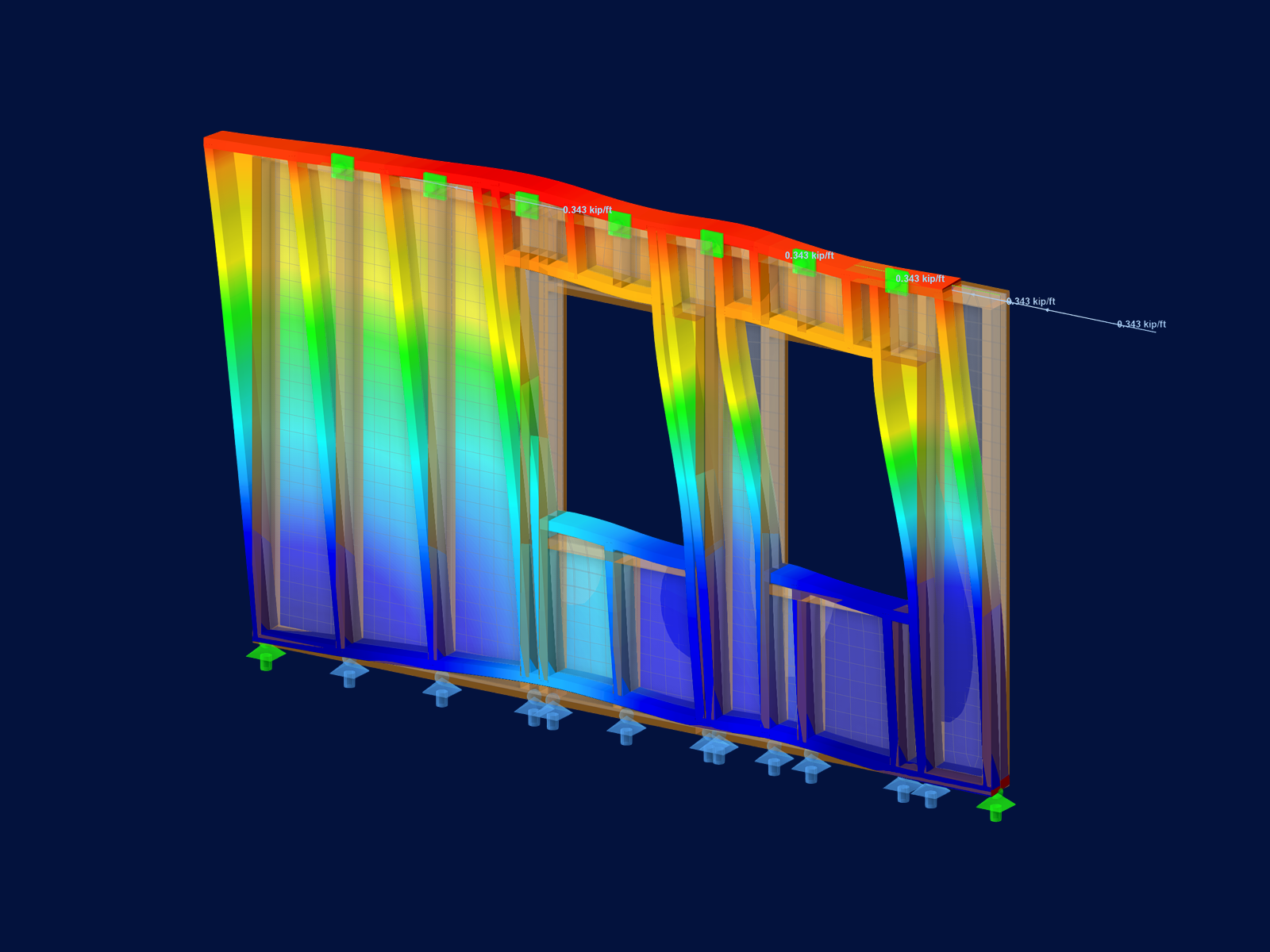
Residual Stress Meets Facade – Cold-Formed Glass in RFEM Planning Process
A facade glass pane that is bent cold during installation carries that stress permanently, and this session shows how to capture it in RFEM 6. An insulating glass unit is modeled with the Glass Design add-on, bent into shape with imposed nodal deformations applied through a helper construction, fixed in its frame, and loaded with wind, all as construction stages. The results show how the stresses of each stage are checked to DIN 18008, and why the load duration makes the permanent bending rather than the wind the governing case.
Webinar language
 English
Recommended skill level
Skills you will gain
- Build an insulating glass unit as a glass composition and turn it into a solid glass composition model
- Apply a cold-bending shape through imposed nodal deformations on a helper construction instead of on the glass
- Connect a helper construction to the pane with rigid links and line hinges that couple only the bending direction
- Model bending, fixing in the frame, and wind as construction stages that carry stresses into the final state
- Explain why permanent and short-term loads lead to different design ratios under DIN 18008
This webinar includes
Webinar content
Andreas Hörold introduces Ulrich Lex, who develops the Glass Design, Masonry Design, and Construction Stages Analysis add-ons. Ulrich sets out the three parts and the two reasons glass gets cold-formed: a curved facade built from panes made flat and bent on installation, and a facade that ends up not quite plane because of installation tolerances.
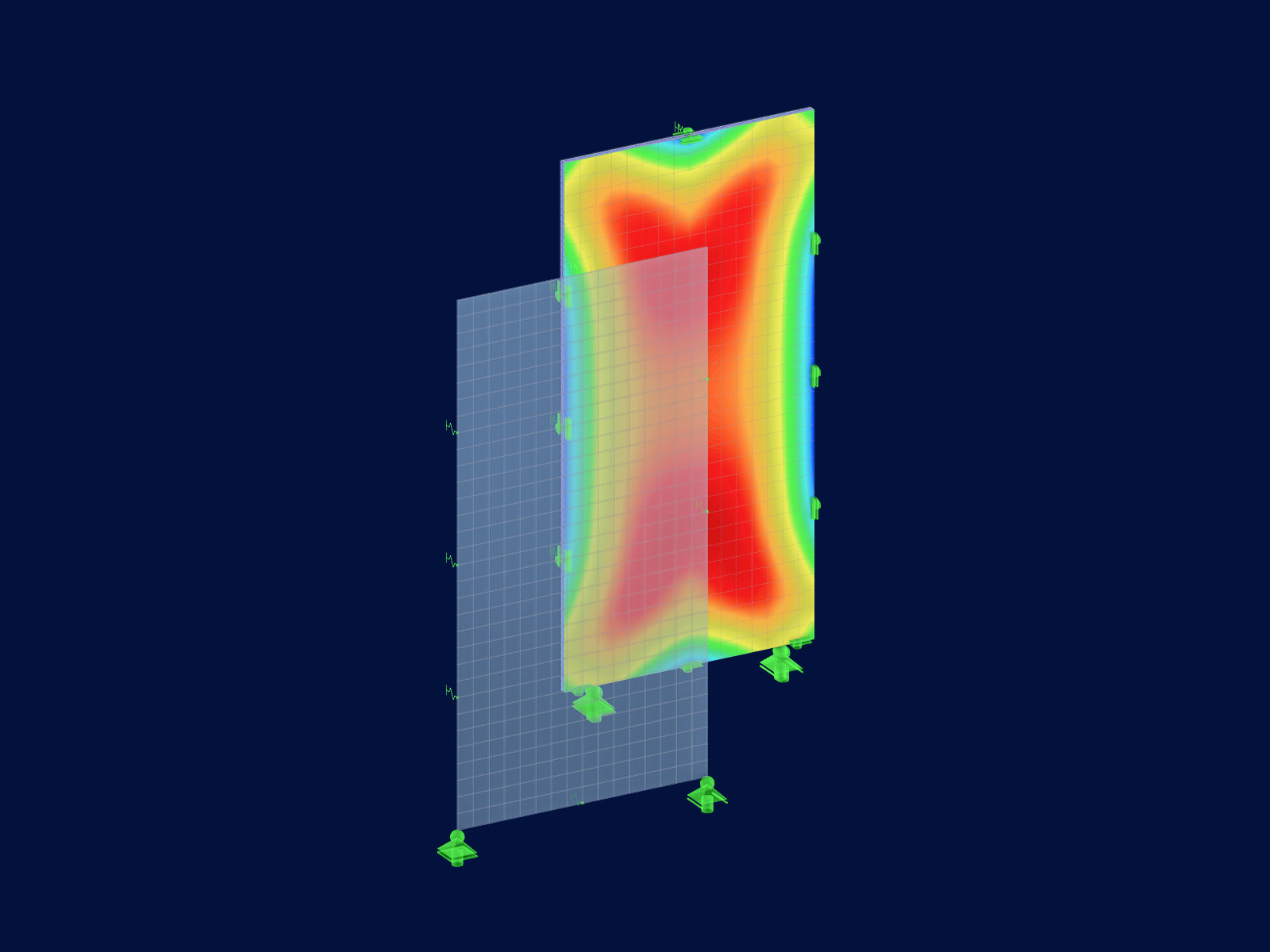
The base data activates Construction Stages Analysis and Glass Design with DIN 18008 and tightens the geometric tolerance for small radii. An insulating glass unit is assembled as a glass composition and placed on a plane surface with elastic line supports and nodal supports, and the glass composition model becomes a solid model with its supports per layer and a user-defined spacer.
Two load cases hold the bending and the wind. The bending could come from a load with springs or from imposed line deformations, which only vary linearly, so imposed nodal deformations are chosen. To keep stress peaks out of the glass, they act on a helper member just off the pane, held by supports with soft springs.
Rigid links run from the helper member to the pane edge, with a line hinge that couples only the bending direction and keeps the others soft. The segment also shows how to add line hinges to the automatically generated glass composition model, and warns that these connections can be lost when the composition is changed later.
The bent shape is entered as imposed nodal deformations derived from the target radius, either from a prepared list or from a formula, growing from zero at the fixed edge to the full offset at the free one. Applying them through the helper construction rather than directly on the glass avoids internal forces from restrained movement in the plane.
Three construction stages describe the installation: the pane is bent, then fixed in the frame, and finally the helper construction is removed and wind applied. Loads are assigned per stage, the analysis settings are matched to the stages, and the combination wizard creates combinations that carry the stresses from the bending stage into the final state.
Only the glass design is calculated, because load cases computed on their own would lack the supports of their stage. The results set the bending stage against the final stage, and the bending governs: DIN 18008 treats the imposed deformation as permanent and the wind as short-term, with different factors on the allowable stress that cannot simply be mixed.
Who this webinar is for
- Facade engineers designing curved glazing that is produced flat and cold-bent on site
- Engineers assessing the extra stresses from installation tolerances in a facade that is not quite plane
- RFEM 6 users who design glass with the Glass Design add-on and have not yet combined it with construction stages
Application areas:
Industry:
Role:
Product:
Webinars review
I would like to thank you for the webinar on "Torsional Warping (7 DOF)". It was one of the best webinars I have ever seen. Thanks to your clear explanations and illustrative examples, I finally understood several things that I had not fully understood before.
Ing. Aleš Kupča
Statika KUPAL s.r.o.
I really enjoyed the coaching course on dynamic analysis. … It was a good introduction to the seismic design. A particularly positive feature is the option to use the various tools used in the training by downloading a demo version during the training—that was a really good addition.
Karen L.
TÜV NORD Ensys GmbH & Co. KG
I am a student at the Technical University in Nuremberg and am currently working on my master's thesis using Dlubal Software (RSTAB). The coaching course on dynamics (EC 8) was very helpful for me. The course was conducted in an extremely professional manner.
Gleb Chernyshev
Germany
The Concrete Structures EC2 with RFEM 6 course content was very satisfactory and well-structured, making it easy to follow. … In short, the course is interesting and introductory—a perfect introduction to the topic.
M.Sc. V. Zinkevych
Obermeyer Holding GmbH
I would like to thank you for the opportunity to try out RFEM 6. … I would like to mention that I'm excited about how much information and webinars you share.
Ing. Ida Grünwaldová
Czech Republic
Was an excellent Webinar | 2018 NDS CLT Design in RFEM 6! Thank you.
Juan Alberto Tello Fuente
CUMBRA INGENIERIA
Due to your webinars and test versions, I started a new job as structural engineer on January 1, 2023. For this, I would like to thank you and your team.
Dipl.-Ing. Ayman Al Shouha
Germany
Unfortunately, I didn't have the opportunity to follow the live webinar, but due to your recording, which I've watched, I am very excited about the current possibilities of RFEM 6. … I was particularly impressed by the speaker!
Prof. Dr.-Ing. Henning Lungershausen
University of Applied Sciences, Trier
Thank you, the webinar "The Most Common User Errors with RFEM and RSTAB" was very informative!
Dipl.-Ing. Adam Balogh
ThyssenKrupp Industrial Solutions AG
I would like to thank you again for the very good webinar "Stability Analysis in Steel Structures with RFEM and RSTAB". In some points, I was able to get clarity and it helped me a lot. I will probably use this more often in the future.
Dipl.-Ing. Johann Mair
MÜHLBERG Beratende Ingenieure GmbH, Mühlberg + Mair Beratende Ingenieure GmbH
The "Soil-Structure Interaction in RFEM" webinar presentation was excellent and the topic was very interesting.
Prof. Lazaros Vasiliadis
Democritus Univestity of Thrace (DUTH)
The webinar "Design Cold-Formed Steel Sections According to EC3" was great. It was my first webinar and I would like to follow more in the future. Especially for new users/students like me and if too fast, it is very good that it is recorded and you can watch it again.
Veronika Klöck
Germany
Thank you for the webinar "Design Cold-Formed Steel Sections According to Eurocode 3." I really liked it. The webinar recordings are a real plus point. Continue to do so!
Bernd Jäckel
Gesellschaft für Planung und Vermessung mbH
I really enjoy watching the webinars you showcase on YouTube. They helped me to convince my client to recently purchase RFEM. They provide a wealth of information.
William Lefort, P.Eng.
Danwill Canada
I have watched the webinar recording "Design of Cross-Laminated Timber Panels (CLT) According to Eurocode 5" on YouTube, and I am impressed by the program and the very good presentation.
Dipl.-Ing. Lothar Reichle
Ingenieurbüro für Statik und Baukonstruktion
The webinar about RWIND Simulation was very successful! From now on, it is possible to analyze wind forces on geometries of objects that are not regulated in the standard. The wind force assumption according to the standard was often a more or less good estimate.
DI Dr. techn. Wolfgang Billensteiner
Civil Engineering Office DI Dr. Tech. Wolfgang Billensteiner
Your webinar on RWIND Simulation was very impressive. Like the speakers at the info days, the speaker confidently described the performance of the new program.
Ing. Johann Tauß
Austria
RSTAB is a software program that I recently discovered and which is very helpful for the calculation of steel structures. With the webinars available on the Dlubal website, I have familiarized myself with the various functions of the program.
Daisy Amila
Algeria
I watched the webinar "Dlubal Information Day Online 2014 – Part 2: RFEM 5 – Structural Analysis with Finite Elements for Concrete and Steel Structures" from 2014. It is a good and powerful video!
Dipl.-Ing. Thomas Steinkühler
Bojda Planungsgruppe
I've attended the webinar on glass design. Excellent explanation. I don't design glass structures; however, it was very interesting to explore the potential of the software.
Ing. Simone Luca Tanghetti
Studio Tanghetti
I've been using Dlubal's programs for most of my university studies. In the beginning, RFEM was far from being a mainstream software, so I didn't have many colleagues to advise me, but thanks to the well-designed controls and webinars, I quickly learned how to work with it.
Ing. Martin Závacký
Brno University of Technology
The webinar Timber Connection Design in RFEM and RSTAB was very successful! I am particularly pleased that you explained how to select the SFS intec dowel system WS-T. Thank you very much!
Caroline Göttlein
SFS intec
Instructors
Dipl.-Ing. (FH) Ulrich Lex
Product Engineering & Customer Support
Ulrich develops the glass structure features and runs the quality assurance processes in RFEM, while also supporting users directly.



Dipl.-Ing. (FH) Andreas Hörold
Marketing & Public Relations
Andreas creates technical content and public relations material for Dlubal and hosts the company's webinars in German and English.

Related Webinars